Showing posts with label 2014. Show all posts

Monday, April 27, 2015

February 2015

The heavy winds last month seemed to have slowed the growth of the veggies. Or perhaps it was just the time of year? But some taller crops surely didn't look so good after the winds. The pole beans, tomatoes, eggplants and such all have had a down turn. But lower growing veggies look good.

Below are the last of the rat tail radishes. Everybody is pretty tired of trying them. They were a nice novelty. Good fresh in salad or for dipping, ok added to stir fry. I bet a good use would be as pickles. But we grew far too many plants. In the future we will limit it to 6 plants. 

The daikons are something that grow real well. Below is a Korean type. They got quite large and still stayed good quality. We liked these quite a bit because we could leave them in the ground longer without them becoming pithy. Thus the harvest could be extended. 

Below is the last of the rat tails we are harvesting for the time being. 

These pallet boxes are proving to be excellent compost makers. As we can find more free pallets, we are making more boxes. 

The compost soil we get out of each box looks and smells quite nice......

The celery we planted us starting to grow up. We have been harvesting individual stems for cooking. 

Another herb tht we harvest individual stems as needed is the chocolate mint. It is a nice flavoring. 

Our cilantro is going to seed. We are planning to use done of the seed for replanting. The rest will go for seasoning. 


January 2015

Good news, bad news month. The bad news first.......major wind storm. While no trees fell into the garden itself, we did have one giant tree smash into the lunch area, destroying both the lunch tent and the potting/work area tent. Both tents were a total loss. On top of that, one lunch table got broken. Bummer. Trees also fell onto the chicken and rabbit pens, severely damaging both. Only one hen died. Poor girl. But happily all the others, including the rabbits, survived unharmed. They all got loose and ran amuck for several days, but in the end everything was fine. 

Good news....

Two new pipinola beds got created. We are using dead standing trees as trellises for the vines. We built a low rockwall around the tree, filled in the bed with horse manure, compost, and soil. Then planted several pipinolas around each tree. They should be producing in about 6-9 months, were aiming for 6. 

We get excess from the garden that does not get eaten, sold or given away. Mostly it's damaged and misshapen stuff, or the rest of the plant parts that don't get harvested. If it's edible, then it goes to feed livestock, otherwise is heads to the compost boxes. Below are two new baby pigs that are the newest recipients of the garden waste. These cute little guys already have told us that they don't like green beans, but the love sweet potatoes, both roots and vines. 

Bad news.....

Grasshoppers. We started seeing holes in the Chinese cabbage leaves. We were thinking it was slugs but we caught grasshoppers in the act of munching. So we went looking for them by using a stick to brush the leaves, causing the hoppers to jump. Gotcha! 

Another insect we are seeing around the perimeter of the garden is the walking stick. So far we haven't spotted any in the garden itself. We don't know if they would damage our garden or not. 

Another pest we see from time to time is the sphinx moth caterpillar. It eats the sweet potato leaves. We don't see many and frankly we don't mind having a few use the garden for the supermarket. We have plenty of sweet potatoes and are willing to share with a few moths. 

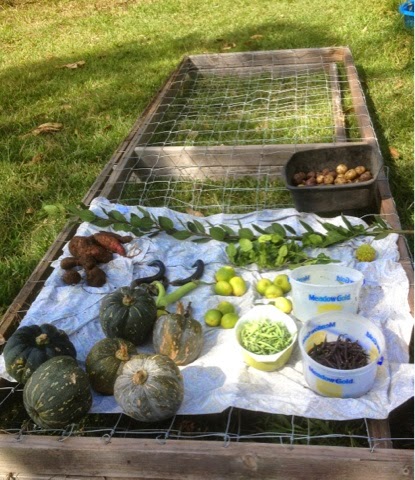
Harvest still include a nice variety of veggies. 


December 2014

The garden is producing quite a bit of extra now. Basically we have its & bits of extra herbs and greens, plus carrot tops. Some of these go to the rabbits as a treat. The rabbits are growing big. 

We have nearly all our starter beds planted or set aside for crops soon to be planted. So Matt is creating more beds. It's a lot f work. Digging. Removing rocks. Breaking up the clumps. Adding manure, compost, etc. Here's Matt pictured below. 

We are adding another section of pole beans now. We are not sure what the timing between the plantings should be, but for now we are sowing a patch every two weeks. 


The garlic chives really like our garden. They are fine for cooking. We plan to see if they can be used as  a pest deterrent. 

This months harvest are including bok choy, n addition to the other veggies. 


We have been harvesting a lot of cucumbers lately. But we are starting to see some problems with the pickleworms. This cucumber, below, just had one worm in it. So half the cucumber was salvageable. But we are starting to see many pickleworms and they are ruining the entire cucumber. We're not sure yet how to control this pest. Spraying dipel on the female flowers every day surely helps, but the evening drizzle washes it away too fast. So were considering other options. 
Above, you can see the hole that tells us that there is a worn inside. 

Above, we cut open the cucumber to reveal the light green "maggot". 

Above,  those holes in the flower are created by the pickleworm "maggots'. 

Above, this is what the pickleworm moth looks like. It is a night time moth. About 3/4" long and ours are more grey than brown. 


November 2014

As we are expanding the garden, we discovered that we needed more tools. More volunteers -- more tools. That makes sense.
Some of us like to dig with a shovel, others prefer a garden fork. So e would rather weed. Yet others like to work on getting rocks removed. So we keep a selection of various tools handy. 

Farm dog.....Mr. Crusty. Crusty us finally getting use to the garden volunteers. He's a shy dog and as been watching the garden goings-on from a distance. He's finally starting to join the group and us accepting a bit of petting. 
The pole beans have exploded with growth. They at now on their way of climbing the trellises. We've harvested all the radishes that had been planted along the edges. So the two crops go together well, not interfering with each other. 

You can see how the pole beans climb the trellis. They don't have tendrils, but rather the whole stem windsI itself around and around the pole. 

This is a variety of purple basil we are trying. It's ok but not spectacular. Everyone so far prefers the genovese variety, 

This is a lemon basil. Personally I find it goes nicely with chicken dishes. I bet it would make a nice tea. We grew far too much of this stuff for our needs, so we are feeding the excess to the rabbits. They love it. 

We are still getting a nice variety of veggies each week. Our green peppers are pathetic. We need to put more effort into them. 


October 2014

The garden is growing larger each week. We're gradually getting more and more beds derocked and planted. This means that we need a lot more mulching material. Since the county mulch is no longer available to us here in Ka'u, we are resorting to using grass clippings. Because the garden is growing in size, we need to upgrade the way we get clippings. No more push mowers. We have switched to using a lawn tractor. The garden group doesn't own one of these, but the owner of it generates clippings for the gardens. 


A large grassy area is needed to supply the clippings. By large, I mean acres. A neighboring macnut farm is allowing us to mow their grass. Those five acres are giving us plenty of clippings to use as mulch or to turn into compost. 

A lawn tractor can create lots and lots of clippings, far faster than a push mower. In fact, it's a mountain of clippings! 

In order to get the clippings back to the garden site, we load them into trashcans then truck them back. The trashcans makes it easier to bring the clippings right to the spot in the garden that they are needed. 

Above, there are more and more garden beds being created and planted. 

This is our first baby watermelon. Watermelons are very difficult to produce in Hawaii because of the fruit fly. But we hope to get a few before the flies find the garden. 

The pole beans are bushy now and about a foot tall. While waiting for the pole beans to grow, we planted radishes. The low plants along the front of the bean row are the radishes. 

Squash stem borer is another problem in the area. We are trying an experiment. Can we confuse the squash borer by hiding the vines under a grass mulch? 


Our harvests this month include a nice variety of veggies each week. 


September 2014

Compost is one of our main sources of fertilizer for the gardens. We use no commercial chemical fertilizers. So we make a lot of various kinds of compost. In the photo below, we've opened up one of the compost making boxes in order to use the material in the garden beds. We spread a light layer on top of the soil and lightly dig it in before planting the next crop. 


We make a variety of composts. Some have more manures for a nitrogen boost for the garden. But most commonly we make a compost based upon vegetable matter.....weeds, discarded veggies, old veggie plants, grass clippings. As we make the compost we add a little soil, lava sand, coral sand, wood ash, and crushed burnt bone. If we have it we'll also add a bit of biochar and mushrooms. We don't have an exact science about it, but the compost works. The veggies grow well. 

Above, these are bean plants in flower. This variety does real well at our location and produces heavily. An added bonus is that the pods are purple, making it easier or the volunteers to see and pick them. We find that purple podded varieties are a bit tougher, but not much. And raw they are just as fine as the green and yellow types. 

Another form of fertilizer we use is manure, compost, and grass clippings tea. We're experimenting to see if these three teas result in differences in the garden. We're just starting to try using teas. 

The garden is coming along. As one bed is harvested, the next crop goes in. So the garden is constantly looking different. Some weeks it is simply bursting in greenery while other weeks it looks empty because new plantings have just been made. 


Thursday, August 14, 2014

August 14, 2014

A few people that didn't make it Tuesday came to the garden today. With just a bit of effort, we got a few more things accomplished. 
A new area is just about ready for planting. It's been sprayed a couple times with vinegar & lime juice, treated with wood ash, process bone and coral. The mulch is in the process of covering the burnt grass. A spot for planting was derocked and rabbit manure tilled in. Good area for??? Spagetti squash? Pumpkin? Gourds? 

An old tarp was spread out in order to create an area for potted plants. They need to grow for a while before we can sell them. Sales help pay for new seeds and tools. So far we have some ornamental taro growing. Next will be assorted sweet potatoes, tomatoes, and others. 
The tents had been taken down in preparation of the hurricane, so today they went back up. Same with the tables, chairs, and other supplies. Above is our little potting tent. Below, Missy is getting everything back in order at our lunch area. 

Laurie worked on weeding and sowing sweet corn. We also had numerous short pieces of white pipe dropped off for the garden and we got them placed around beds that still needed border markers. 

It's still raining almost daily. As a result lots of things are sprouting, but slow to grow. The new peas, beans, bok choy, and radishes are all up now. A few of the potatoes have made it up. But the poor tomatoes just sit there praying for sun. We are starting to see some damage to the green tomatoes....some rot, some slug damage. Dang rain! 

Today we were able to harvest a few things -- beets, Chinese kale, dill, basil, onions, cucumbers, bok choy. 

Tuesday, August 12, 2014

Aug 12, 2014

Today was basically a rain out. We didn't have much time to get anything done before that rain started.  But here's a garden update:

Zucchini squash-- the plants are starting to show signs of mildew on the leaves. When we started removing the affected leaves we saw that stem borers have been attacking the plants. 
All the plants had their main stems destroyed. But odd thing was the plants themselves.  Half the plants seemed small, quite a bit of mildew, but not dead. No flowers. The other half were thriving, very little mildew, and had flowers. Why the difference? The thriving plants had put down roots along their stems above the borer damage. 
So we may be able to take advantage of this plant behavior. By pulling soil and mulch up around the stems, the plants could send out new roots, making the plants stronger and better producing. Looks like the plants would be able to fight off the mildew better too. We will have to do some experimenting. 

Another one of the grow boxes is ready to dismantle. With the rain today, this job will be postponed for next week. 

We did get the two grow boxes replanted with sweet potato cuttings. 

Before the rain came we got a bit of harvesting done, but because of the goat attack, it isn't a lot. 
...shelling peas, a modest amount
...bok choy, enough for everyone to take some
...little onions, enough for everyone
...purple green beans, a modest amount
...enough dill, basil, and parsley
...cucumbers, enough to go around

We are seeing more damage from the pickleworm. Perhaps it is time to try an experiment to block the moth at night. Maybe something simple like laying screening atop the plants to see if that is sufficient to block the moth. We'll give it a try and see what happens.